Posts

Showing posts with the label downbursts

Nova: "Rain Bombs"

Image
This episode of Nova  where they, for reasons unknown, rename wet downbursts "rain bombs" is a mis-mash. They attempt to take things weather science has known for 50 years (discovered by the late Dr. Ted Fujita) and make them new discoveries. The producers also imply we cannot forecast them. None of that is true.  And, as you would expect, they try to tie downbursts to global warming -- in spite of a lack of evidence.  They do have some terrific video of downbursts. The one right after Dr. Marshall Shepherd's first appearance (above) is great. If you watch, notice the curl at the lower left side of the screen as the downburst spreads out. That is the fingerprint of a downburst.  © 1978 Michael R Smith The problem is that this science, including the curl, has been known since 1978 -- there's nothing new about it. It is found in Fujita's book on downbursts.  It feels like the producers ran out of ideas and Rain Bombs  is the result. I wish it had been better....

Tonight's Plane That Didn't Crash

Image
One of the reasons weather science is not respected for its amazing accomplishments is because many are invisible. We may have had a big success earlier this evening.  A thunderstorm developed near St. Louis' Lambert International Airport (KSTL for weather and aviation purposes) about 5:30 and drifted slowly south. It produced a series of downbursts -- which are highly dangerous to aircraft when landing and departing.  Here's the success story: Nothing happened! In 1973, a downburst caused the crash of an Ozark Airlines flight as it was on final approach to Lambert . There were 38 people killed. There was no system for warning pilots of these dangers.  Two weeks ago, we commemorated the 40th anniversary of the awful crash of Delta Flight 191 at Dallas-Ft. Worth on August 2, 1985 . The crash killed 137 with 20+ more injuries. Some of those injuries were horrific. The NTSB determined that the crew flew into the thunderstorm, knowing it was a thunderstorm (both FAA and Delt...

Early Start to Your Christmas Shopping

Image
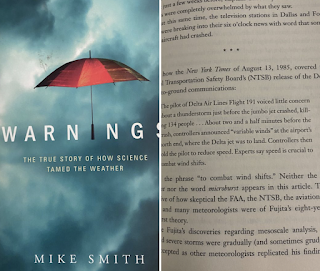
As of the time of this posting, the price of this great book is a great bargain! An independent survey shows Warnings: The True Story of How Science Tamed the Weather is the 17th best selling book about weather of the past few decades. Written in the form of a novel, it tells the story of how we learned to warn of hurricanes and tornadoes and prevent once-frequent airliner crashes due to downbursts -- saving hundreds of lives. Amazon says: The discerning audience at Goodreads rates it highly.  Based on past years, the price goes up as Christmas approaches. Books make great gifts. Consider starting your shopping early while you can take advantage of this great price!

Why Fujita's Downburst Discovery Was Important Beyond Aviation

Image
USAir 1016's wreckage on the west side of Charlotte-Douglas International Airport Many times, we have discussed the terrible airline crashes caused by downbursts. Examples, here and here . Several times this summer, there has been significant downburst damage to towns and cities.  But, Ted Fujita's discovery was important to atmospheric science in other ways. Kathleen and I were cleaning out some files last week and ran across this.  Notice the sub-headline, Tornado May Have Hit Trailer Park.   The local emergency management and National Weather Service personnel informally agreed to call the damage a tornado because there wasn't anything else, they thought, to call it. The problem was there was no "hook echo" (this was well before Doppler), the atmosphere over south central Kansas was not conductive to tornadoes, and no one saw a funnel cloud.  Just five months earlier, Dr. Ted Fujita and his mentor, Dr. Horace Byers, published their landmark paper in Monthly We...

See You Tomorrow

Image
I'll be speaking at Love Field's Museum of Flight at 11am.  Bring your copy of Warnings  and I'll be happy to autograph it for you. 

Please Come See Me in Dallas!!

Image
I'll be appearing at Love Field's  Frontier's of Flight Museum  on Saturday, May 6.  I'll be speaking about downbursts at 11am. If you have a copy of one of my books, I'd be happy to autograph it for you. I'll also have copies of  Warnings  for sale. The price will be $20, including tax. More here: The list of speakers is below. Note the great prizes.  Really looking forward to seeing everyone Saturday!

New Review of "Warnings"

Image
Brittany Glish A new review of Warnings: The True Story of How Science Tamed the Weather  was posted at LinkedIn Saturday. Here are some excerpts: Wow! Absolutely blown away by  Mike Smith  book.  Mike wrote several chapters on Delta 191, while giving an informative, yet tactful explanation of what happened. He describes beautifully not just how impactful microbursts are on aircraft and all the research behind it, but just how understudied and misunderstood they were at the time. If you are interested in weather or meteorology, or maybe just an aviation nerd like myself, I highly recommend this book! Thanks for your research and time dedicated to this book, weather, and aviation, Mike. Thanks, Brittany! Warnings is a great book for spring break or as a graduation gift for a meteorology graduate. 

The Great Dr. Ted Fujita

Image
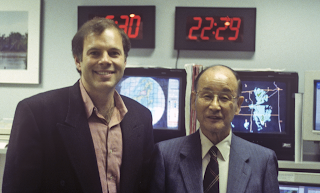
Ted Fujita was the most amazing meteorologist of my lifetime.  Ted Fujita in 1993 during one of his visits to WeatherData, Inc. He took a forensic approach to studying weather and, among other accomplishments,  Discovered the downburst which stopped what was them the #1 cause of airline crashes Created the Fujita Scale of tornado damage Discovered so much about tornadoes that I can't list all it here Photo of rain "curling" in a downburst Copyright 1978, Michael R Smith AccuWeather published a well-done biographical article Ted this morning. You'll enjoy reading more about him!

"Heat Burst" in Northern Oklahoma

Image
About 11:20 this evening, a heat burst occurred near Ames, Oklahoma, which is in the eastern part of Major County. A heat burst is a downburst that occurs as a thunderstorm dissipates. It causes very high winds and rising temperatures, even at a time of day when the air is usually cooling.  At 11:09pm, what was left of a thunderstorm that originated in the Texas Panhandle  By 11:40, it was gone. The circles near Enid and Waukomis are reports of wind damage.  The highest wind reported, so far, was 71 mph at the Oklahoma Mesonetwork's Lahoma station, along with a temperature rise of 3°F. Vance AFB outside of Enid reported 70 mph and Enid's Woodring Field reported at gust of 68 mph. Based on radar, there may have been even stronger gusts over parts of eastern Major county.  While some wind damage occurred with the heat burst, these are, unfortunately, impossible to forecast. 

Meteorologists: Spearhead Echo

Image
Northwest of Dodge City at 5:11pm CDT was a "spearhead echo" -- a predictor of damaging downburst winds. And, sure enough, radar sensed winds to 73 mph five minutes later which is the strongest winds I have seen from this storm.  The regular KDDC METAR 18 minutes before the above image recorded calm winds; so the 73 mph gusts from this storm were entirely generated by convection -- no pressure gradient involved. While Doppler radar showed the highest winds passed west of the airport, it still recorded a 62 mph gust. Because this is an infrequent occurrence, I wanted to document it for my meteorology friends. You can find more on this topic here .  UPDATE: The gust front had passed DDC at the time the balloon was launched so here is the AMA sounding. This is a classic "Inverted-V"sounding characteristic of downburst winds. 

The Story of How the Storm Warning System Came to Be

Image
As we get into the statistical heart of tornado season 2021, this is the only book on the topic of how the storm warning system came to be: Warnings: The True Story of How Science Tamed the Weather .  The warning system doesn't just encompass tornado warnings,  Did you know that downbursts were once the #1 cause of commercial airliner crashes? Because of one courageous meteorologist, the last U.S. downburst crash was in 1994.  A single unwarned U.S. hurricane killed 8,000 people (which would be 13,000 today due to population increase). We've prevented that type of disaster.  The evacuation ahead of Hurricane Katrina was one of the largest peacetime evacuations in U.S. history -- and it saved 40,000+ lives.  With graduations, Mother's Day and Father's Day coming up, I hope you'll consider picking up a copy. 

Weekend Fun: Incredible Thunderstorm Wind Video

Image
While there are all kinds of thunderstorm-related winds in this video, the videos of downbursts are some of the best I have ever seen. Watch it full screen, turn up the volume, and forget about politics!

Have You Ever Experienced a Downburst?

Image
When the video begins, note the stoplights are out because the downburst has caused the power to fail in the area. The trees aren't moving in the non-rainy air. When he drives into the rain, the trees are swaying and the rain is very heavy. This is typical of downbursts. If you would like to learn more about how we tamed downbursts, tornadoes and hurricanes, may I recommend my book , below. It is the non-technical, gripping story of how meteorologists risked their careers to create the storm warning system.

To: Aircraft Investigators Working on the Air India Express Crash

Image
Via Bloomberg If this anonymous source article is correct, I would respectfully ask investigators to reconsider. I know that at least several airline investigators read this blog based on feedback I have received pertaining to articles I have written about past air crashes and incidents. The information in the article, if true, concerns me. It is possible weather is being prematurely ruled out.  The article says that the "tailwind" was blowing at 12 to 13 knots. However, planes are supposed to land into  the wind (headwind conditions). A 15 mph tailwind, by itself, may have been a factor in aircraft touching down in the middle, rather than the end (where it is supposed to be) of the runway. Second, the fact the wind was blowing at 12 to 13 knots at the primary weather station is not necessarily an indication that there wasn't a microburst on the landing runway. I was an expert witness in the crash of USAir 1016 in 1994. The center-field (primary) weather...

Delta 191: A Sad Anniversary

Image
Courtesy: Ft. Worth Star-Telegram Used with permission Today is the 35th anniversary of the crash at Delta 191 at DFW International Airport. The crash killed   136. Twenty-five were injured; some of the injuries were horrific. This event was one of the most important in the history of aviation safety. The data collected evaluated Dr. Ted Fujita's hypothesis that downbursts were responsible for an increasing number of airliner crashes. Once this was finally accepted, effective measures could be taken to stop the crashes . Only one has occurred since, in 1994. Downbursts are just as dangerous as ever. There was a downburst-related crash in Mexico in 2018. It is a combination of training and technology that has allowed us to conquer them in the United States. I devote three chapters of Warnings  to this scientific success story. I covered this topic on this blog on past anniversaries: 25th anniversary coverage .  30th anniversary coverage .  It is a terri...

Caught a Downburst

This was yesterday afternoon. The thunderstorm was near Peabody, Kansas. If you look closely you can see the "foot" of the downburst spreading to the right near the ground. It is a time lapse. For information on Texas downburst from last week, click here .

Dramatic Downburst in Amarillo This Afternoon

Image
The National Weather Service's Amarillo office took quite a picture of a downburst at 4:02pm CDT this afternoon (hat tip: Mark Fox). Here is the raw image. It becomes even more impressive when the air flow is superimposed. A downburst, discovered by Dr. Ted Fujita after his examination of the crash of Eastern Airlines Flight 66 in 1975, is an extreme hazard to aviation due to wind shear in both the horizontal and vertical. On radar, nothing ominous is present on radar at 3:52pm. click to enlarge The black circle is the location of the radar at the airport. That is the location of the photo. The left is the "reflectivity data" which depicts how hard it is raining. This is the type of radar display you typically see on television.  On the right is the Doppler wind velocity data. Nothing unusual there, either.  At 3:57, a core of intense rain, with some hail, makes its presence known (black oval, left). It is rapidly descending through the thunderstorm...

"Mr Tornado," May 19

Image
PBS is going to run a one hour "American Experience" titled Mr. Tornado  -- the story of Dr. Ted Fujita. I can't tell you how much I am looking forward to it. The trailer is  here . Ted, who passed away in 1998, was a friend of mine -- and, the most brilliant scientific mind I've ever experienced. Working with him on downbursts, the Hesston Tornado, and his visits to WeatherData, Inc. were peak moments of my career. PBS/WGBH called me early on in this project and I helped as I could. Thrilled my friend is getting this honor and I can't wait to see the final product.

Downburst! Close Call at Reagan National Yesterday

Image
This dramatic video of a commercial airliner doing a missed approach at Reagan National at 5:27pm EDT yesterday was taken by Dave Statter (@STATter911). The photo (below) is of the rain curtain associated with the downburst at it approached Reagan National Airport. In a downburst, high winds begin as the rain arrives. Trees were toppled minutes before it hit the ground at Anacostia about two minutes before this screen capture. Dave's video (above) depicts the missed approach. The jet (circled) is making final approach to Runway 19. The leading edge of the downburst is beginning to move across the runways. click to enlarge The plane was about to land. Two other planes are waiting to takeoff at the end of the runway. The plane, now inside the downburst, makes a missed approach and starts to climb out. The plane is now behind the building in the background. I enhanced the contrast of the rain.  The arrows show the wind flow. Wind shear is a rapid change in...

Today Is an Important Day For Weather Science...

Image
and, for America! It is the 25th anniversary of the last airliner crash caused by a downburst. Weather science has done wonders but, for the purposes of aviation, nothing exceeds the conquering of the downburst. From a news story five years ago.  My piece at the Washington Post's  Capital Weather Gang column about this milestone is here . Some additional thoughts: Here is one of my seven photos of the lifecycle on a downburst. One look at this photo revealed something unique was in progress -- it wasn't an ordinary downdraft as most in meteorology believed at the time. The stress on Ted Fujita (center, below), because of his unpopular downburst hypothesis, was unimaginable. The "consensus" throughout meteorology was that he was mistaken. Dr. Ted Fujita visiting WeatherData, Inc. Nevertheless, he marshaled his courage, persisted, and was proven correct -- unfortunately, it wasn't until nearly 300 more airline passengers has perished. I tell the...