Posts

Showing posts with the label railroads

First EF-5 in 12 Years

Image
The first tornado rated EF-5 since the 2013 Moore Tornado occurred in North Dakota in June. The 12 year EF-5 "drought" (longest in recorded tornado climatology) has ended.  The tornado's path is in purple. The full story of the rating and the tornado is here . Here's a photo of the damaged train used in the rating. Note the scouring (lighter brown in field on this side of the derailed cars) which only occurs with stronger tornadoes.  The North Dakota EF-5's path is quite similar to the 2007 EF-5 Greensburg (KS) Tornado's path. A map of the latter is below. It is an interesting coincidence the Greensburg Tornado crossed the Union Pacific's "Golden State Route" on the north side of town and blew over railcars parked on a siding.  FYI: The above is a coincidence, not a characteristic of EF-5's. 

Attention: A Suggestion for the Southeast - Railroads

Image
Emergency Managers: How about using railroads  to get large amounts of materiel to the areas that need it? From what I have been able to determine, there is less damage to the railroad infrastructure that I would have guessed.  Railroads go through some of the most remote terrain in the United States and can move huge amounts of freight.  Asheville is near the center of the map. Blue is CSX Railroad the gray is Norfolk Southern. There are several shortline railroads in the Asheville area.  I don't know whether railroads can help but we won't know if we don't try. 

A Meteorology Success Story!

Image
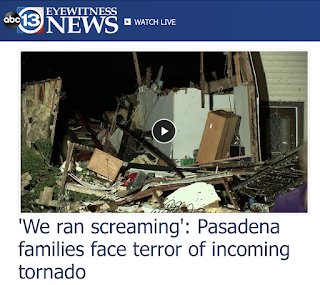
We had a major tornado pass through the densely populated area of southeast and east Houston with other storms east into the Beaumont-Port Arthur-Orange area. Later, tornadoes developed in Louisiana.  As of 11:22pm there has not been a single fatality. That is an amazing scientific accomplishment and all of the meteorologists involved: NWS (especially the Storm Prediction Center), broadcast and commercial meteorology should be praised! There is one story I wish to tell. Take a look at the photo below.  Those railroad hopper cars were blown over by the Houston Tornado. Because the railroad got advance notice of the tornado, the train was stopped when the tornado hit (often, trains are too large a target to get out of the way). You can see that the track is in pristine condition.  If the train had been moving, it would have torn the cars apart, tornado apart the track and, possibly, put cars or contents in the water (foreground). That would have been far more expensive to t...

Stock Up on Necessities: Rail Strike Possible

Image
Unless Congress or President Biden intervene, there will be a railroad strike this week. If that occurs, the supply chain issues we currently have will mushroom. Therefore, I'd like to encourage you to purchase extra necessities before the strike occurs.  UPDATE: Wednesday, September 14, 4:40pm CDT

Sunday Fun: The Last Time We Had Big Inflation

Image
Back in the 1970's when we had huge inflation, many companies made television commercials to show how they were doing their part to keep prices down. So, for our Sunday fun, here are some inflation golden oldies. 

Trains and Trafficking

Image
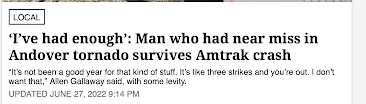
This man has had a bad year. A close call on April 29 in Andover    (above) and then yesterday's Amtrak crash.  Some serious thoughts: Yesterday was the second day in a row with a mass casualty Amtrak crash where a rural road crossed mainline tracks that requires drivers to turn their heads more than a 90° angle. I annotated a Daily Mail  illustration below.  Sunday's nearly identical crash was in California.  Rural or not, we need to get lights and gates at all mainline crossings where the road is not at a 90° angle to the tracks.  While the three crossing deaths in Missouri yesterday and the three in California were tragic and preventable, the human tragedy in Texas was far worse.  Fifty precious people died in that truck in Texas yet it is receiving far less coverage than the Amtrak accident. This is not acceptable. The border must be secured and we must stop human trafficking. 

Video of a Dangerous, and Avoidable, Amtrak Crash

Image
This has been a bad week for train accidents.  Last night, a truck hauling automobiles got stuck on the BNSF tracks in far southern Oklahoma in front of Amtrak's Heartland Flyer  with predictable results.  The blue arrow points to the crossings' signal box, which I'll come back to in a moment. A reminder:  If you observe a car or truck stopped on the tracks or other irregularity, call the number on the crossing's signal box immediately. This goes to the railroad and it is the fastest way to get trains stopped. Then, call 9-1-1. If a crash cannot be avoided, get away from the tracks  first then, if possible, run in the direction from which the train is coming (while staying well away from the tracks). That way, any debris from the crash will be carried away from you.  Earlier this week, a Chicago man pulled a man in distress away from a car stuck on the tracks. I appreciate the Chicago man's heroism in pulling the man to safety. Video is below. 

This is Railroad Safety Week

Image
There are three rules on which I want you to focus after reading this piece about railroad safety: 1. Never play, work, or photograph on railroad tracks! Period. No exceptions! Hollywood film crew, even though they were denied permission by CSX Railroad, was hit by a train while shooting on a bridge. Even though they had a  lookout, one died and one was seriously injured. In a terrible irony, a person in California was killed on tracks this morning .  2. If a car or truck is stuck on tracks, call the railroad first,  then   call 9-1-1. Every public railroad crossing in the United States has unique identifying information to quickly get trains stopped. Here's how to find it:  If there are flashing lights or other mechanical warning devices, the information will be on the electronics hut along with an (800) phone number. Call that and read off the information on the box. Then, call 9-1-1. If it is a rural crossbuck: I apologize for not having a rural cr...

One More Time: Don't Take Photos on Railroad Tracks

Image
I am appalled that Associated Press published this photograph  yesterday. Those are active railroad tracks  (you can tell by the polished rails). Over and over and over people die needlessly because they are on, or are very close to, tracks. Please don't be one of them!

Please Stay Away From Tracks During The Tour of Union Pacific #4014

Image
Updated, December 9, 2019: Like the horrible example below, the woman in the purple coat (above) was literally inches from losing her life. The engineer was frantically blowing the whistle but she didn't understand the message was for her. As the locomotive passed, she leaned backward a bit but the train was still close enough to rip fabric from her jacket. I bring this up because bystanders in a similar incident looked at the camera after the train passed and it was set to wide angle, which makes objects appear more distant.  This was my hypothesis (below) pertaining to the fatality involving Union Pacific's steam engine #844 (see below). Because it is exciting to see these wonderful machines, I don't fault anyone for using a wide angle setting. I do fault people for being far too close to the tracks. If they stayed back the recommended 25', they would have seen it better. Don't believe me? Here is a screen capture from my sister's video of the Big Boy ...

Sunday Fun: Why Railroads Need Advanced Weather Warnings

Image
While awaiting a phone call, the television was on Turner Classic Movies and there was a 1931 picture playing titled Other Men's Women.  As a meteorologist and railfan, this segment caught my attention. If only they had precision storm warnings in 1931! Today, AccuWeather Enterprise Solutions provides track-specific storm warnings for most of the major railroads in North America. In 2016, a segment of Union Pacific track, with a speed limit of 70 mph, washed out west of Topeka. Fortunately, we told the railroad about the danger. They sent a track surveyor to check and, sure enough, the bridge was gone. So, unlike the fictional washout in 1931, catastrophe was avoided.

Stay Off Railroad Tracks!

Image
Tuesday, a young man in Oregon was killed taking a senior picture on railroad tracks. Please don't -- far too many are being killed this way.

Be Careful At Railroad Crossings

Image
Ugh. An auto truck got hung up at a crossing with sadly predictable results. The video is here . Yes, that is an auto flying up in front of the locomotive's cab. Especially with the new school year starting: it is a good time to remind all concerned of the dangers of railroad crossings. 

More From the Golden Spike Ceremony

Image
It is almost impossible to overstate the importance to the transcontinental railroad to the development of America. I've already written about Union Pacific's part of the celebration. It is a genuine shame the national media largely ignored this historic and well-presented event. Thanks to railroad photographer Colorado Zephyr, here are photos of the reenactment ceremony which occurred May 10. Here is a video of the wood-burning replica of Union Pacific's #119 moving into position. Engineer Tom Brown is at the controls.  Here is the inside of the steam lomomotive. There was a musical, As One,  to commemorate the joining of the United States. As One  excerpt: The performers taking their bow. Congratulations to the organizers, performers, Union Pacific and to the United States of America. 

Congratulations, Union Pacific Railroad and to America

Image
One hundred-fifty years ago today [May 10, 2019], the "Golden Spike," connecting the Central Pacific Railroad (the west coast) to the Union Pacific Railroad (Midwest and East), was driven. That was the culmination of President Lincoln's dream to unite the United States via rail. Before the Golden Spike, it took two weeks to get from New York to California via unloading your ship, walking across Central America, and reloading a second ship to sail to San Francisco. Or, you could spend months  on a single ship sailing around the tip of South America. The two locomotives above (#4014, left, and the #844) are were there to recreate the iconic photo of the Jupiter (Central Pacific, left) and the #113 (Union Pacific) when the Golden Spike was driven. Central Pacific merged with Southern Pacific which was purchased by Union Pacific in 1996, thus the single railroad represented today. So, congratulations to Union Pacific and to the United States on completing President L...

No, They Are Not "Setting Fire to the Railroad Tracks"

Image
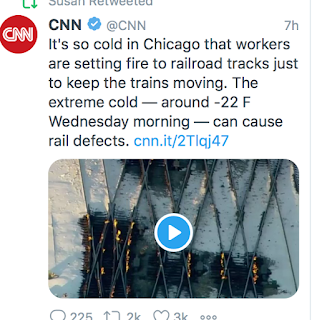
Arrggghhh. I've seen this factually incorrect tweet about "setting fire to railroad tracks" from ABC and CNN literally dozens of times the last 24 hours. They are not setting fire to the tracks. First of all, the tracks are metal and metal does not burn. What they are seeing are picturing are switch heaters (image below). The heaters melt snow and ice to prevent them from "fouling" the switch. Below is an example. The arrows point to the switch "points." The points move (left to right in the photo) to grab the flanges of a train's wheels and direct the train into the siding as shown here or, with the points moved to the right, keep it on the main line. On a heater-equipped switch, butane is burned to melt the precipitation. Above is a view of the switch heater and butane tank in good weather.

This Scares Me to Death

Image
I was watching a live railcam at Tehachapi, California, a few minutes ago and saw this. When the gates came down three boys charged toward the tracks.  I don't know if these boys were playing "chicken" with the oncoming train or if they were just trying to get home. Regardless, what they did is a good way to get killed. The reason they are lit so brightly is because they were in the headlight of the fast approaching locomotives.  It is very easy to trip at railroad crossings due to the gap for the train wheels' flanges. Had one of them tripped, it would have been an extremely close call. Please teach your children to respect railroad crossings and signals. 

Railroad Tracks: Danger!

Image
Too many people are getting killed along railroad tracks in America. Below is an example from Saturday afternoon in Flagstaff, Arizona. The man is standing right next to one set of tracks as a train passes. Had a train been coming from the opposite direction, he would likely have been killed. The noise of the first train could have prevented him from hearing a second train approaching. A woman was killed in June standing too close to the tracks in Colorado as a train approached. You can see her a second before her death in light colored-clothes on the right side of the tracks. Please stay away from tracks and teach your children to do the same!

Railroad Tracks Are NOT The Place For Prom Pictures

Image
A few minutes ago, I made these screen captures from the San Juan Capistrano rail cam. In the first, there are what appear to be three prom couples posing for pictures on the tracks. And, moments later, the inevitable train. As far as I could tell, the tracks cleared as the train approached.Regardless, railroad tracks should never  be used for photography or any other purpose except running trains. Please don't!!

Rail Safety Week: Please Take Heed

Image
It Is National Rail Safety Week! There are way too many people putting themselves in harm's way to get artsy photos these days. Don't.  You can't believe how quiet today's trains are. Regardless, if you are focusing on something else, you may not hear the train's horn. If you were on/near the track and focusing on something else, would you hear these trains? There is a photo is so tragic that I can't bring myself to post it, but Union Pacific has the last selfie and the story of three teenage girls who were standing between two rail lines (e.g., such as between the two sets of track above) as one train passed by. Even though a second train from the other direction was frantically blowing its horn, the girls never heard the train coming from the other direction. All three perished. It can take a half-mile to stop a train! One other bit of rail safety: If the crossing is on , there is a moving train near! The sensors in the track know whether a t...