Posts

Showing posts with the label Climategate

The Full Story on Climategate

While somewhat technical, Ross McKitrick and Steve McIntyre have written the definitive summary of Climategate and its aftermath .

Tenth Anniversary of Climategate

Image
By pure coincidence, Climategate  broke  ten  years ago, this  blog's first  day of publishing.  The newspapers in Great Britain did a far better job covering the biggest scandal in the history of the atmospheric sciences than did their counterparts in the United States. The U.S. MSM did the very best it could do to cover up this story of major scientific misconduct. This blog's first story on Climategate What was most shocking to me were the awful positions taken by the American Meteorological Society and other scientific organizations that, defacto, sided with the wrongdoers. After a few weeks, Climategate, wrongly, faded from the public eye. The MSM, in fact, continued to spout the nonsense from these extremists in the intervening years. I don't have the heart or stomach to recount all of Climategate. If you are new to the story, here are some excellent links: From The Quadrant, here . WattsUpWithThat  (one of t...

If You Would Like to Go Deep into Climategate...

...click here . It tells, first-hand from the main participant, about the climate clique's attempt to evade laws regarding release of public data.

Did the U.S. Government Participate in Hiding Climate Data?

This would be a significant scandal, if true.  (link fixed, thanks)

The National Association of Scholars Takes on Climategate...

...and they get it just right . It begins, Climategate, both 1 and 2, are textbook cases of gross lapses in professional ethics and scientific malfeasance. Author H. Sterling Burnett goes on to say, Climategate parts one and two are a series of leaked e-mails from arguably the most prominent researchers promoting the idea that humans are causing catastrophic global warming. The e-mails show the scientists involved to be violating their professional ethics with the result that climate science in particular and science as an institution more generally is brought into question.  The first group of e-mails released in 2009 showed scientists attempting to suppress or alter inconvenient data, destroying raw data so that others would be unable to analyze it, using tricks to change reported outcomes, conspiring to avoid legally required disclosure of taxpayer-funded data, and trying to suppress dissent by undermining the peer review process.  On the latter point the researchers...

Dr. Ross McKitrick: Fix the IPCC or Fold It!

Published in Canada yesterday, please read the whole piece : F or many years, attempts to encourage debate on global warming science or policy have run into the obstacle that the UN Intergovernmental Panel on Climate Change (IPCC) has issued definitive statements, and therefore—the reasoning goes—the era of debate is over. The IPCC is made up of thousands of the world’s top scientists, it has one of the most rigorous and exhaustive review processes in the history of science, and the oversight by 195 member governments ensures balance, transparency and accountability. Or so we are told. These claims about the IPCC are not true, but until relatively recently few were willing to question what they were told. Things began to change in 2009 with the leak of the Climategate emails, which prompted some observers to begin questioning their assumptions about the IPCC. Then this fall, Canadian investigative journalist Donna Laframboise released her book  The Delinquent Teenager Who Was Mi...

Sickening

As I mentioned yesterday, Climategate 2 has broken. Some background: Climategate 1 was the release of thousands of emails to and from the clique of climate researchers around the world who have been highly influential in the United Nation's Intergovernmental Panel on Climate Change (IPCC). Along with the emails was some computer code used in various climate projects. Climategate 1 was important because it cast doubt on the science behind perhaps the most important argument of the pro-catastrophic global warming case: The "hockey stick." The hockey stick purported to show that temperatures are warmer now than they have been any time in the past 2,000 years. Climategate showed the "blade" of the hockey stick to be -- and, I'm being kind here -- an invention. Climategate 1 also showed -- unquestionably -- the subversion of the scientific method by the leaders of the climate science 'cause' (see below). For me personally, this was the worst aspect ...

Yes, I Know Climategate 2 Broke Today

However, I do not comment on these things until I have independently examined the evidence. I'm very busy with AccuWeather (my day job) work today, so I'm not sure when I'll get to Climategate 2. If you want to follow it right now, please let me refer you to WattsUpWithThat .

Steve McIntyre on Berkeley's BEST Project

If you want to learn more about why the 'science' in the BEST project (subject of all the "why you shouldn't be a skeptic anymore" headlines) is deficient, the inimitable Steve McIntyre chimes in .

Climategate, "Hide the Decline" Explained Easily

Image
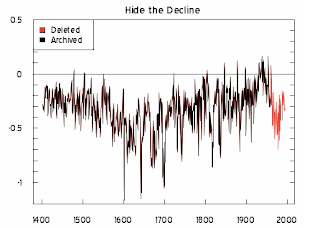
From that hotbed of political conservatism, University of California Berkeley. I appreciate the honesty of Professor Richard Muller. He says, of "hide the decline*" that "this is not acceptable in science." Exactly! * As we have discussed on the blog before, "hiding the decline" was done by Prof. Michael Mann (with the collusion of others) to splice temperature data onto tree ring data (the tree ring data showed recent temperatures going down, calling the validity of the entire project into question) in a way that no one would notice. This created Al Gore's and the IPCC's (and others') famous "hockey stick" graphic. While on the subject of Climategate, there is a new editorial in the British press. It concludes, We now know that the work done at Climatic Research Unit barely qualified as science; they kept it secret to stop other scientists checking it; thus breaching one of the foundations of the scientific method. To stop p...

One Year Anniversary of Climategate

This weekend is also the one year anniversary of "Climategate" where a hacker or whistle-blower (we don't know which) released emails and other data from prominent climate researchers. The emails revealed illegality (deleting emails to avoid Freedom of Information Act requests), attempts to deceive ("hiding the decline" [of temperatures]), and duplicity (i.e., saying in public that global warming is "incontrovertible" while, in private, asking "where is the warming?"). While global warming is one of my least favorite subjects, I write about it because it is important and so much of what the media publishes on this subject is incorrect. That said, it was a coincidence that the blog was started at the same time as Climategate, but it certainly gave me plenty to write about the first few days! If you would like to read the posting that alerted me to the emails release, go here .

Why Should Climate Science Get a Pass?

I dislike writing so much about global warming because I sense readers are as tired of the subject as I am. Nevertheless, I want to bring your attention to a column that will likely be picked up by the mainstream media. You'll remember Climategate which started 11 months ago with the hacking/release (no one knows which except the person[s] who did it) of emails and other communications between various pro-GW scientists. This column talks about one of the least well-known aspects of Climategate, some "comments" regarding the computer code used by the British to compute average global temperatures, When hackers leaked thousands of e-mails from the Climatic Research Unit (CRU) at the University of East Anglia in Norwich, UK, last year, global-warming sceptics pored over the documents for signs that researchers had manipulated data. No such evidence emerged, but the e-mails did reveal another problem — one described by a CRU employee named "Harry", who ofte...

R.I.P., Hockey Stick

Image
If there is a single icon for 'global warming,' it is the "Hockey Stick" (HS) created by Dr. Michael Mann. The HS was featured on the cover of an IPCC report and was featured in Al Gore's movie, An Inconvenient Truth. Not only did the HS purport to show that recent temperatures are unprecedented but that the well-known Medieval Warm Period (MWP) didn't exist (see graph below) which, until the HS, was accepted by most meteorologists and climatologists. From almost day one, the HS has been controversial. Steve McIntyre and Ross McKitrick published two peer-reviewed papers calling the HS into question. McKitrick commented, "The Mann multiproxy data, when correctly handled, shows the 20th century climate to be unexceptional compared to earlier centuries." In other words, the temperatures we are experiencing now are not higher than those of 900 years ago!   If today's temperature levels have been previously reached naturally, before humans s...

The (Non) Investigations into Climategate

You have probably been reading about the post-Climategate investigations that 'clear' some of the participants. Not so fast. Here is an excellent story on the subject of why Climategate is important and why the 'investigations' were far from satisfactory.

A Terrific, Valuable Interview

James Lovelock is an environmentalist and inventor of the Gaia theory. Here is a terrific interview with him regarding the current state of climate science. By the way, Lovelock believes in global warming and is quite concerned about it. Some quotes, "Fudging the data in any way whatsoever is quite literally a sin against the holy ghost of science. I'm not religious, but I put it that way because I feel so strongly." "We tend to now get carried away by our giant computer models. But they're not complete models. They're based more or less entirely on geophysics. They don't take into account the climate of the oceans to any great extent, or the responses of the living stuff on the planet. So I don't see how they can accurately predict the climate." "We do need scepticism about the predictions about what will happen to the climate in 50 years, or whatever. It's almost naive, scientifically speaking, to think we can give relativel...

A Fascinating Online Discussion

Image
Michael Mann's climate reconstruction of the past 1,000 years that created Al Gore's famous "hockey stick" hid the fact the 20th Century tree ring data did not match the temperature data. The tree rings indicated temperatures went down in the 20th Century when the thermometers indicated temperatures rose. Here is a graph from Anthony Watt's blog showing the tree ring temperatures declining in recent years. This is the famous "hide the decline" from Climategate. If the tree data was truly representative of temperatures, the tree ring data would have shown increasing temperatures. So, the "divergence" of the 20th Century tree rings from the thermometer data obviously called the entire exercise into question. Rather than simply disclose this, they made the decision to splice  the temperature data onto the tree ring data. The "trick" was discovered by Steve McIntyre who discusses it here . The researchers truncated the declining ...

The Windfather

Conflicts of interest abound along with a potential organized climate  crime connection in this non-investigation into Climategate. Take it away, Tom Fuller . These sorts of conflicts of interest are occurring in the United States, as well.

Earth Day Letter From Richard Lindzen

Richard is the Alfred Sloan Professor of Meteorology at MIT. His Earth Day letter is here .

Manipulation of the Climate Record

The 1930s were warmer than recently depicted. More here .

More Climate Science Hijinks

Unfortunately, some in climate science appear not to be learning the lessons from Climategate. Here is the concluding paragraph from Roger Pielke, Sr.'s blog : Ross’s entire article is worth reading. I also will be posting further examples of this deliberate attempt to surpress scientific studies which refute or raise serious questions on the IPCC perspective in the coming weeks and months. In science, papers should be published in journals based solely  on their scientific merit.  Anything less is a perversion of the scientific process. For readers who are not scientists, here is how the process works:  A scientist has an idea or hypothesis that he or she wishes to communicate to the larger scientific community. It is sent to the editor of a scientific journal who sends it to three reviews who are supposed to have expertise in the specific topic discussed in the paper. Those reviewers are anonymous, in theory so they will be free to be critical. Fine. However, gi...